
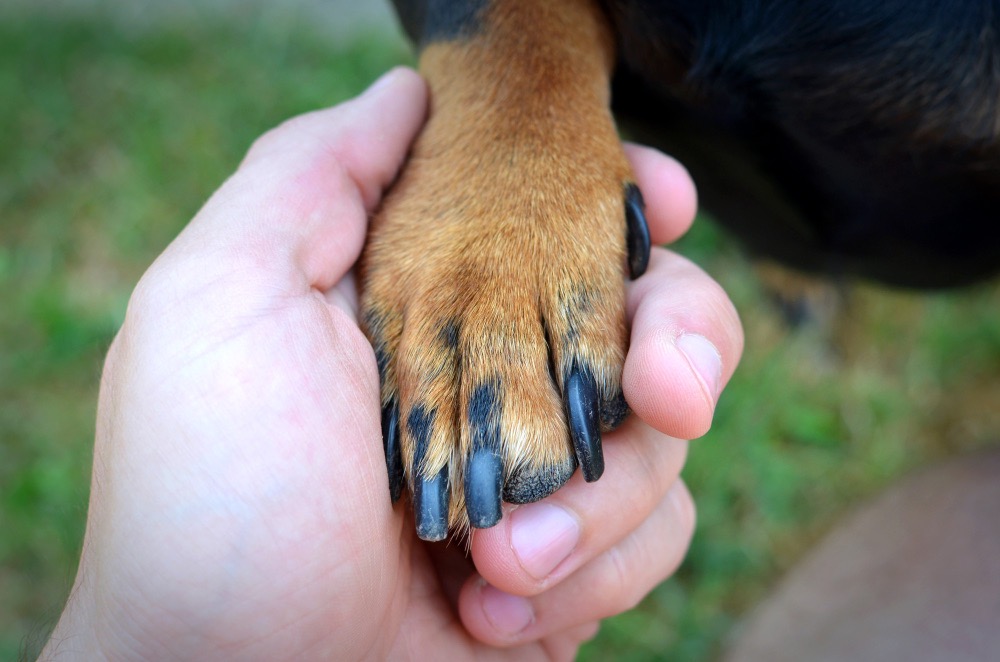
When spending quality time with your pup, you may notice that your pup always offers the same paw when you ask for it during training, or maybe they always step forward on the same side when getting up from their dog bed.
This may not be random. It is suspected that dogs—like humans—have a dominant hand, or rather a paw. Researchers have found that many dogs consistently favor one paw over the other, a phenomenon known as paw preference or paw dominance.
While not every dog shows a strong preference, this behavior can provide insight into how a dog’s brain functions, processes emotions, and responds to the world around them. Understanding your dog’s paw preference is about better understanding your pup.
What Does It Mean for a Dog to Be Right- or Left-Pawed?
Similarly to humans, dogs may be:
- Right-pawed, favoring their right side
- Left-pawed, favoring their left side
- Ambilateral pups, having no strong preference of either side
Paw preference is a natural trait that reflects a process called brain lateralization, meaning that each side of the brain may specialize in different functions.
In humans, the left side of the brain is primarily responsible for language, logic, and analytical thinking, while the right side of the brain plays a larger role in emotional processing, intuition, and interpreting social cues.
In dogs, the left and right sides of the brain are associated with different emotional and behavioral responses, which helps explain why paw preference may be linked to temperament and stress responses.
What Science Says About Dog Paw Preference
Scientific studies on dog behavior and brain lateralization suggest several consistent findings:
- Most dogs show a reliable paw preference when observed over time.
- Paw preference may be linked to emotional processing and behavior.
- The left and right sides of a dog’s brain influence how they respond to stress, novelty, and familiar environments.
Some studies suggest that left-pawed dogs may be more emotionally reactive, particularly in stressful or unfamiliar situations, while right-pawed dogs tend to show more stable or relaxed responses overall.
That said, it’s important not to overgeneralize. Paw preference is only one small piece of a dog’s overall behavior, and there is a myriad of other factors that influence your pup including individual personality, environment, and training.
Paw preference offers insight—not diagnosis. Your pup is a unique being with other unique factors influencing them.
How to Tell If Your Dog Is Right- or Left-Pawed
You can tell if your dog is right-pawed or left-pawed with a few at-home tests… and a little patience. Observing your pet’s paw dominance can be a fun at-home activity to help you create some quality time, add an activity to a cozy night at home, and ultimately build a deeper understanding with your furry friend. It is like taking a personality quiz, but for your dog: fun, revealing, and not that serious.
- The Kong or Toy Test: Place a stuffed Kong or chew toy between your dog’s paws and observe which paw they use most often to stabilize it.
- The First Step Test: Watch which paw your dog steps forward with first when getting up from rest position, whether they are standing up from a bed, couch, or floor.
- The Shake Test: Take note of which paw your dog consistently offers when asked “shake” or “paw.”
- The Stair Test: Observe which paw leads when your dog naturally starts climbing stairs.
For accuracy, repeat each test several times. Paw dominance is determined by consistent patterns over time, not a single observation.
Looking for More Insight into Your Dog’s Behavior? Contact Us Today.
Exploring your dog’s paw preference can be a fun and meaningful bonding activity. But if you’re looking to build a deeper understanding of your dog’s behavior, communication, and emotional responses, professional training can help.
Training isn’t just for problem behaviors: it’s a powerful way to strengthen trust, confidence, and the human-canine bond.
Contact us today or visit our dog training page to learn more about our training services.